
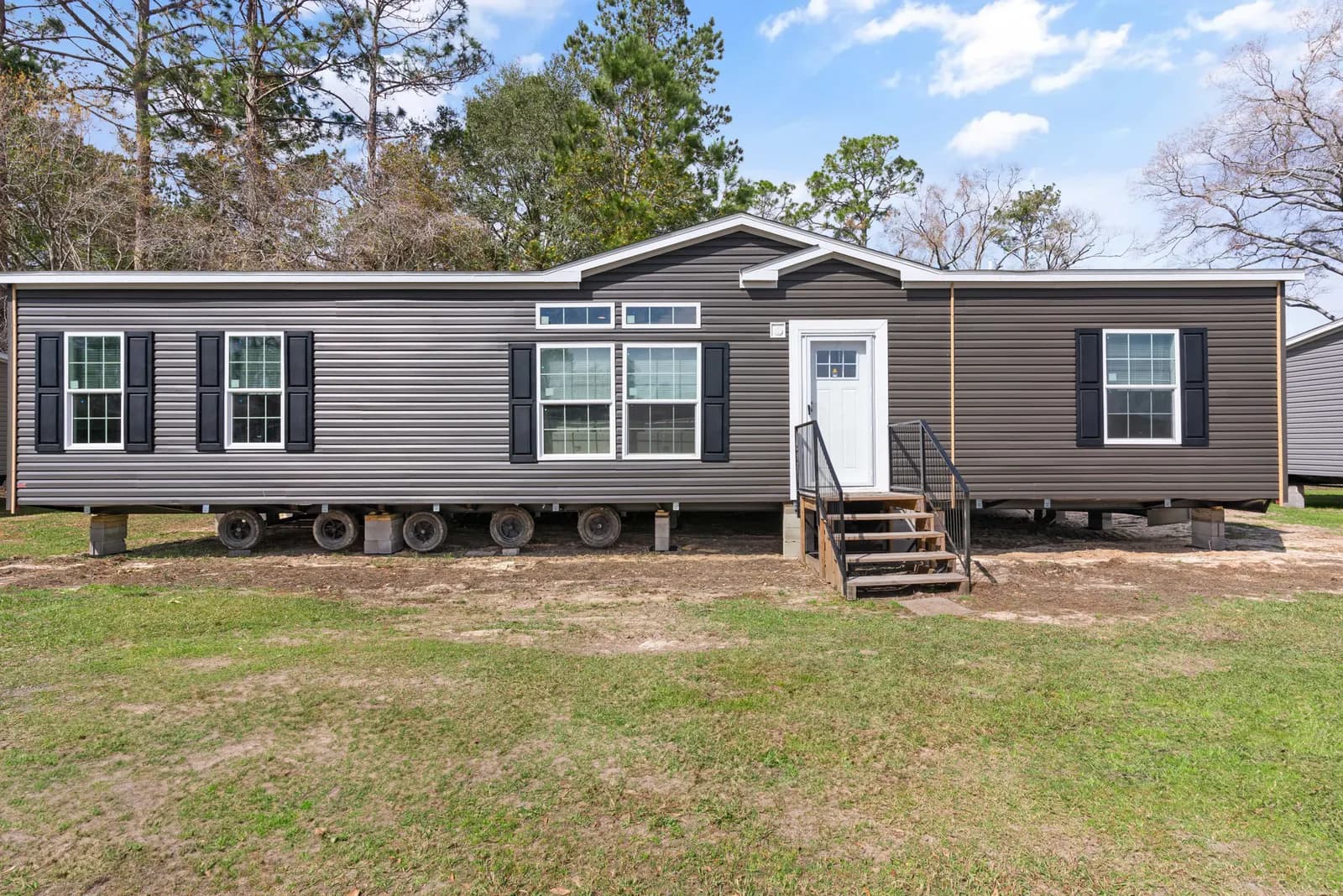
01The long answer
Yes, but really —
are they any good?
A straight answer, including the parts that aren't flattering. If you only read one page on this site, read this one.
02A short history of a bad reputation
Everything went wrong before 1976. Almost nothing has since.
The reputation attached itself to a product that no longer legally exists. Here is the actual sequence.
- 1950s01
Trailers
Eight feet wide, towed behind a car, aluminium skin, no insulation to speak of. This is the thing everybody is still picturing. It was a vehicle, and it was sold as one.
- 197402
Congress steps in
The National Mobile Home Construction and Safety Standards Act passes after a decade of genuinely alarming fire and structural failures. It creates a federal building code — the only one in the United States.
- 197603
The HUD Code takes effect
June 15, 1976. Everything built after this date is legally a manufactured home, not a mobile home. Fire ratings, wind resistance, plumbing and electrical standards, third-party plant inspection. The industry is a different industry from this morning onward.
- 199404
Wind and thermal zones
Post-Hurricane Andrew. Wind zones II and III introduced with dramatically higher structural requirements, plus thermal zoning that ties insulation to climate. Roof loads, anchoring and glazing all tighten.
- 2021—202505
Energy standards
DOE energy conservation standards phase in, pushing envelope performance past most state codes for site-built housing. Duct leakage testing becomes mandatory. Blower-door verification becomes routine.
- Today06
Where we actually are
A 2026 HUD-code home from a good plant is tighter, better insulated and more consistently built than the median new site-built house in the same market. This is not a marketing claim; it is what the testing shows.
03Three different things
Manufactured, modular, site-built.
These get used interchangeably and they are not interchangeable. The differences change your code, your lender, your timeline and your price by a factor of three.
| Criterion | Manufactured (HUD) | Modular (IRC) | Site-built |
|---|---|---|---|
| Building code | Federal HUD Code — one standard nationwide | State/local IRC, same as site-built | State/local IRC |
| Where it's built | Indoors, on a jig | Indoors, on a jig | Outdoors, in whatever weather there is |
| Inspection | 9 third-party in-plant inspections | In-plant + local final | 3–6 local inspections, mostly visual |
| Build time | 8–12 weeks | 10–16 weeks | 7–14 months |
| Typical cost / sq ft | $95–135 | $140–190 | $220–380 |
| Chassis | Permanent welded steel | Removable carrier | None |
| Financing | Chattel, or real-property lending on owned land | Conventional construction loan | Conventional construction loan |
| Appreciation | Follows the land and titling | Same as site-built | Same as site-built |
| Lumber rained on | Never | Never | Frequently |
04Energy
The bill is where the argument ends.
Envelope performance is the one claim in this industry that cannot be fudged, because a third party puts a fan in your front door and measures it. Our homes leave the plant blower-door tested, with the result on paper, in the drawer, in the kitchen.
A factory does this better than a job site for an unglamorous reason: the same crew installs the same window flashing detail four hundred times a year under a roof, at waist height, with the wall lying flat on a table.
The HERS index
Lower is betterA HERS rating is the industry's standardised energy score. 100 is a house built exactly to the 2006 reference code. Every point below that is a one percent reduction in modelled energy use.
05Where the sceptics are right
Three things we are not going to talk you out of.
Any dealer who tells you there is no downside is telling you something else too, and you should listen to that instead.
- 01
Financing on leased land really is worse.
A chattel loan on a rented pad runs roughly two points over a comparable mortgage and amortises over 20–23 years instead of 30. Nobody should pretend otherwise. It is why our first question is always about the ground, not the granite.
- 02
Resale is thinner, and slower.
The buyer pool for a home on leased land is smaller and more credit-constrained. Expect a longer time on market than a comparable site-built house. On owned land with a permanent foundation, this evens out almost completely — but it takes a permanent foundation, not a promise.
- 03
The floor is a real floor, but the market's floor isn't.
There are still bad plants and bad dealers, and the price spread between the worst HUD-code home and the best one is enormous. Ask any dealer for the in-plant inspection reports and the blower-door result. If they can't produce them in a day, walk.
06Common questions
The ones we actually get asked.
Legally, no. “Mobile home” refers to anything built before 15 June 1976, when the federal HUD Code took effect. Everything built after that date is a manufactured home, and the two are governed by completely different rules.
In conversation people use the terms interchangeably, and we are not going to be precious about it. But if you are reading a loan document, an insurance policy or a zoning ordinance, that date is the line that matters.
Both are built indoors and finished on your site, and that is where the similarity ends. A manufactured home is built to the federal HUD Code and carries a HUD certification label. A modular home is built to the same state building code as a house framed on site — in Maine, MUBEC — and once it is set, a code officer inspects it as a house.
That difference decides financing, titling, appraisal and sometimes whether a town will permit it at all. We sell both, so ask us which one your parcel and your lender actually want before you fall in love with a floor plan.
On land you own, with the home on a permanent foundation and titled as real property: yes. Conventional, FHA Title II, VA and USDA all lend on manufactured homes that meet those conditions, and a modular home is financed as an ordinary house from the start. On a leased pad you are in chattel lending, which is a real loan with real underwriting — just more expensive. Which situation you are in is a decision you make, and we would rather you made it on purpose.
Maine issues a manufactured home its own certificate of title, the way it does a vehicle. Once the home is permanently affixed to land the owner also owns, that title is cancelled and the home is conveyed with the real estate from then on.
That step is the one that puts the home on the same appreciation curve — and the same lending shelf — as the house next door. It is worth doing in the right order, and it is one of the first things we will ask you about.
The same as any other house: as long as the roof and the envelope are maintained. HUD-code homes from the early 1980s are still in service across the country. The structural failures people remember are almost entirely pre-1976 units, or post-1976 homes that were never properly anchored — which is a set-crew problem, not a construction problem.
Every home is certified to a wind zone, a roof-load zone and a thermal zone, printed on the data plate inside a kitchen cabinet. Inland Maine is HUD Wind Zone I; only the coast reaches Zone II. Snow is the number that actually matters here, and the roof-load rating on the plate is the one to read.
Maine is also the coldest HUD insulation zone, which is why an envelope specified for a southern market is the wrong home to buy in Kennebec County. Ask us for the data plate on any home before you sign anything — it is a photograph, and it takes us a minute to send.
Still not convinced?
Good. Come and be unconvinced in person — it takes about twenty minutes and a flashlight.